LinkedIn
 Facebook
 Email
Email
 Twitter
 Quickly evaluate current rents with QuickView™ Rent Estimates


6 AI Prompts to Help You Analyze Rental Properties Faster
If you’ve ever entered your deal data into ChatGPT and asked for impartial feedback on a rental property, you’re definitely not alone. Artificial intelligence is rapidly changing how investors analyze deals.
With the right prompts, AI can summarize a property, identify risks, stress-test assumptions, and surface insights and recommendations within seconds. It can be especially helpful with emotionally driven deals, the ones we really want to work, even when logic and numbers may be telling us otherwise.
But there are a couple of important things you really need to pay attention to.
First Piece of Advice: Feed AI Reliable Data
AI is only as good as the data you give it. Anyone who has taken a computer science class has probably heard about the concept “garbage in, garbage out.” No matter how sophisticated a system is, if you feed it poor or inaccurate data, the output will also be flawed.
Stay connected
Get rental market insights delivered straight to your inbox.
If you want useful feedback and reliable analysis, you need to provide accurate inputs. For example, if your rent assumptions are outdated, overly optimistic, or too generic, the entire analysis can quickly fall apart.
That’s why experienced investors still rely on real-world market data and hyperlocal rent comps before making decisions.
That’s where Rentometer fits in. By combining Rentometer’s current rent comps, pre-calculated market statistics, and Deal Worksheet analysis with AI tools like ChatGPT or Claude, investors can move through underwriting faster while keeping their analysis grounded in reliable market data.
Second Piece of Advice: Don’t Treat AI as a Source of Truth
AI systems are very good at spotting patterns, summarizing information, and applying historical trends to your inputs. However, you should be cautious about relying on AI for critical market statistics such as occupancy rates, regulatory changes, tax updates, or even home and rental price trends for secondary markets, as the information may be outdated, inaccurate, or based on incorrect assumptions.
For example, AI models sometimes incorrectly assume that proposed tax or regulatory changes have already been adopted, which can lead to flawed recommendations or unrealistic projections. For secondary markets, AI systems may simply rely on data that is one or two years old.
With that in mind, let’s take a look at six practical AI prompts investors can use to analyze rental properties more efficiently and learn how Rentometer helps provide the foundation behind the insights.
The Workflow: AI + Rentometer
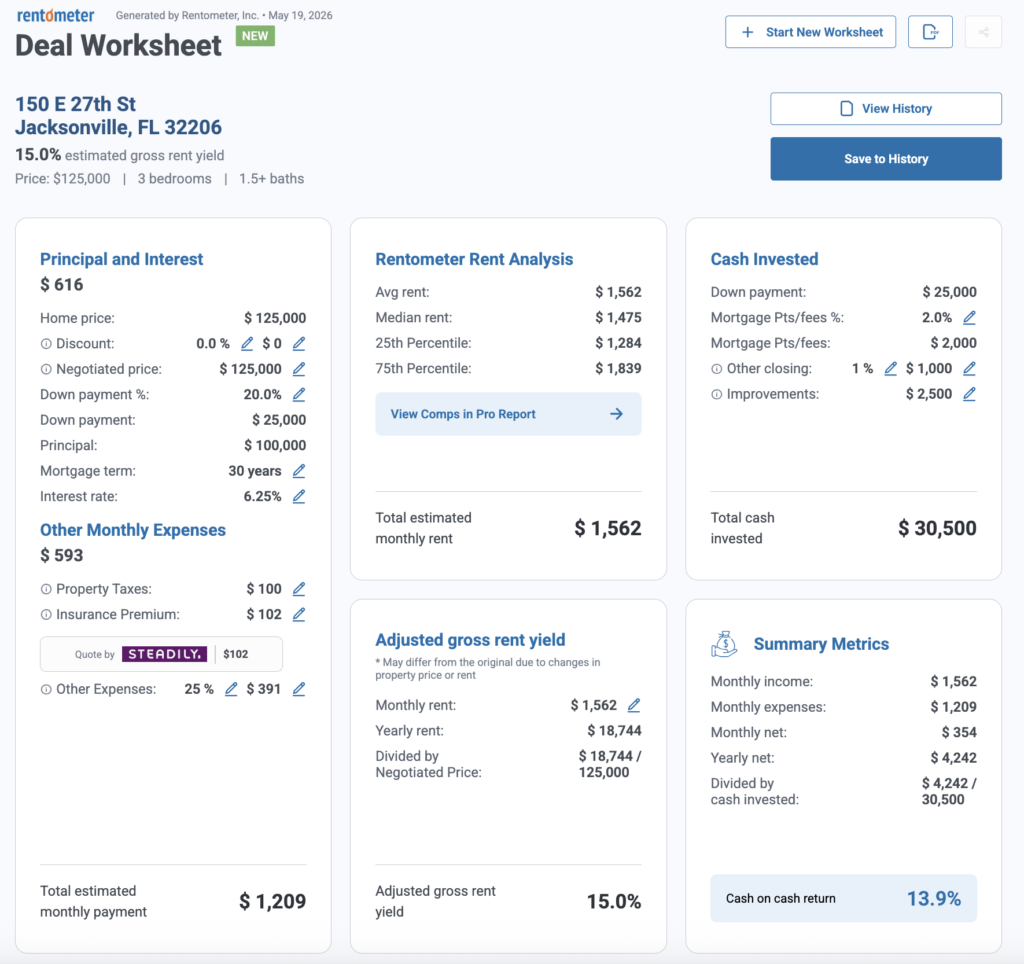
If you’re currently analyzing a rental property and haven’t tried Rentometer’s Deal Worksheet yet, it’s definitely worth checking out.
Instead of juggling spreadsheets, calculators, mortgage tools, and rent comps separately, the Deal Worksheet brings everything together into a single underwriting workflow. It allows investors to quickly estimate financing costs, monthly cash flow, gross rent yield, cash invested, and projected returns — all while integrating Rentometer’s local rent analysis directly into the calculation.
A simple AI workflow looks like this:
- Run a Deal Worksheet in Rentometer for a target property
- Generate a Pro Report with rent comps and market analysis
- Upload the two reports and the property listing into ChatGPT or Claude
- Ask the AI platform to analyze the deal
We tested this AI workflow using a property from Yield Tracker in Wichita Falls with an estimated gross rent yield of 5.2%. Here are some of the insights the AI generated:
From a pure rental investment perspective, this looks fairly weak at the current asking price — at least under today’s interest rates and estimated rents.
- Strengths (e.g. in your supply-constrained market this newer premium inventory will outperform older stock)
- Weaknesses (e.g. you’re paying a premium for new build and modern finishes, but tenants are not willing to proportionally higher rents for those upgrades in Wichita Falls, TX)
- Risky assumptions (e.g. property taxes are generally higher in Wichita Falls, which can easily make your cashflow negative)
- Potential red flags (e.g. this is a negative-cash-flow property in a market that is not obviously a high-appreciation market )
There were also several other useful insights generated, and we encourage investors to try multiple AI platforms, as different systems may provide complementary perspectives and observations.
6 AI Prompts to Help You Analyze Deals Faster
1. Use AI to Get a Fast Investor Snapshot
One of the best uses of AI is generating a quick “second opinion” on a deal.
Prompt #1:
Review these reports from the perspective of a conservative buy-and-hold real estate investor. Identify the top strengths, biggest risks, and any assumptions that should be validated before moving forward.
Why It Works
This prompt helps AI focus on:
- Cash flow stability
- Rent positioning
- Expense sensitivity
- Pricing risk
- Operational concerns
Instead of generating a generic property summary, the output becomes more investment-oriented.
When paired with a Rentometer Pro Report and Deal Worksheet, the AI already has:
- Local rent comps
- Rent ranges
- Projected returns
- Property assumptions
- Market context
That allows it to jump directly into analysis instead of trying to estimate market rents from scratch.
2. Stress-Test a Deal in Seconds
Most deals look attractive under perfect assumptions. The real question is: what happens when market conditions change?
Prompt #2:
Assume market rents decline 5% and maintenance expenses increase 10%. Explain how this would impact cash flow, projected returns, and overall deal risk.
Why It Works
The Deal Worksheet already handles the underlying financial calculations. What AI adds is faster interpretation and contextual analysis.
Instead of simply reviewing updated numbers manually, investors can use AI to help explain:
- Where the deal becomes vulnerable
- Which assumptions matter most
- How risk changes under different scenarios
- Whether the investment still fits a conservative strategy
This helps investors move beyond raw calculations and think more critically about downside risk and deal resilience.
It can be especially useful for:
- Older properties
- Thin-margin deals
- Uncertain rental markets
- Properties requiring renovation
The stronger the underlying rent comps and expense assumptions, the more useful and reliable the AI-generated analysis becomes.
3. Compare Multiple Deals More Efficiently
AI becomes especially useful when reviewing several investment opportunities side by side.
Prompt #3:
Based on the provided rent comps, projected returns, and expense assumptions, compare these properties and explain which appears financially stronger or riskier.
Why It Works
AI should not be treated as an authoritative source on what constitutes a “good” rental deal in today’s market, especially since market conditions, financing costs, and investor expectations change constantly.
However, AI can still be extremely useful for comparative analysis when working from reliable deal data.
For example, AI can help:
- Compare projected yields across multiple deals
- Identify unusually aggressive assumptions
- Flag inconsistent expense estimates
- Surface operational concerns
- Highlight which properties appear more resilient under stress scenarios
When reviewing several properties in a single session, AI can also identify recurring patterns and help investors prioritize which opportunities deserve deeper underwriting.
The key is that the underlying market data, rent comps, and financial assumptions should come from current sources such as Rentometer — not from the AI model itself.
4. Identify the Assumptions That Matter Most
Not every variable impacts a deal equally. Some assumptions barely move returns. Others completely change the outcome.
Prompt #4:
Review this analysis and identify which assumptions have the greatest impact on returns. Highlight which variables should be verified most carefully before purchase.
Why It Works
This prompt helps investors focus on what actually matters.
AI may identify:
- Overly aggressive rent projections
- Underestimated maintenance
- Unrealistic rehab budgets
- Tax increases
- Financing assumptions
- Vacancy exposure
This creates a more disciplined underwriting process and helps investors avoid relying too heavily on optimistic projections.
5. Use AI to Compare Different Investment Markets
AI can also be extremely helpful when evaluating and comparing multiple real estate markets side by side.
Prompt #5:
Based on the provided rent data, property prices, projected yields, and my existing portfolio, compare these markets for long-term investment potential and operational efficiency. Assume I am primarily interested in [SFR / multifamily / Airbnb / commercial / STR] opportunities.
Why It Works
AI is particularly good at organizing large amounts of market information and identifying patterns across different cities and regions. When provided with accurate and current market data, it can help investors compare:
- Projected yields
- Pricing levels
- Rent-to-price ratios
- Operational complexity
- Diversification opportunities
- Portfolio concentration risks
- Potential economies of scale
One of AI’s biggest strengths in market analysis is its ability to incorporate macroeconomic trends and broader market narratives into the discussion. AI can help investors synthesize information related to:
- Population growth
- Migration patterns
- Job creation
- Infrastructure investment
- Supply constraints
- Affordability trends
- Interest rate environments
- Local economic development
This can be especially useful when thinking about long-term appreciation potential rather than just immediate cash flow. AI is often very good at connecting multiple economic signals and explaining how broader trends could influence future housing demand and pricing within a market.
However, investors should still be careful not to blindly trust the market statistics AI platforms reference internally. In secondary or fast-changing markets, AI systems may rely on data that is one or two years old, especially for home prices, inventory levels, occupancy trends, or cap rates.
For that reason, it’s important to:
- Verify the market statistics AI is using
- Provide updated pricing and rent data whenever possible
- Ask AI to revise its recommendations using the latest numbers
Another important best practice is to give AI the full context of your existing portfolio. For example, if you already own multiple properties in a specific region, AI may identify operational efficiencies such as:
- Easier property management
- Shared contractor relationships
- Lower travel costs
- Stronger local market familiarity
- Economies of scale within a single metro area
Finally, specificity matters. Different markets may perform very differently depending on the investment strategy. A market that works well for long-term SFR rentals may be weak for Airbnb, while a city with strong multifamily fundamentals may not perform well for commercial properties.
The more specific you are about your investment strategy and goals, the more useful the AI-generated market comparisons become.
6. Build a Due Diligence Checklist
Once a deal passes an initial review, AI can help organize next steps.
Prompt #6:
Based on this property analysis, create a due diligence checklist of the most important items to verify before purchase.
Why It Works
This helps investors move from analysis into execution.
The checklist may include:
- Lease verification
- Tax confirmation
- Insurance quotes
- Maintenance inspections
- Rent validation
- Neighborhood research
- Financing review
Instead of replacing due diligence, AI helps structure it more efficiently.
AI Doesn’t Replace Real-World Investing
AI can dramatically speed up rental property analysis.
But it does not replace:
- Underwriting discipline
- Market knowledge
- Due diligence
- Investor judgment
- Reliable data
In fact, AI becomes most valuable when paired with trusted, real-world information.
That’s why many investors are now combining AI tools with platforms like Rentometer to:
- Validate rent assumptions
- Analyze deals faster
- Stress-test scenarios
- Organize insights
- Move through underwriting more confidently
The advantage isn’t fully automated investing. It’s faster clarity. And in a competitive market, faster clarity can make a major difference.
Final Thoughts
AI can help investors analyze rental properties faster than ever before.
But the quality of the analysis still depends on the quality of the inputs.
When paired with reliable, hyperlocal rent data and structured deal analysis, AI becomes far more useful, helping investors make more informed decisions.
The combination of AI + real-world rent data may not replace traditional underwriting.
But it can absolutely help investors work smarter, validate assumptions faster, and uncover insights that might otherwise take hours to surface.
Stay connected
Get rental market insights delivered straight to your inbox.