LinkedIn
 Facebook
 Email
Email
 Twitter
 Quickly evaluate current rents with QuickView™ Rent Estimates


Big Homes, Big Differences: Where Renters Find the Most Space in America
What do renters want most in 2026? More space.
A national survey by SmartRent Inc. found that the top reason renters are moving is simple: they want a bigger home. And this isn’t a one-off trend: multiple industry reports point to the same shift, as renters prioritize comfort, flexibility, and room to work from home.
Hybrid and remote work have made extra room for a home office increasingly essential, while Millennials, the nation’s largest renter cohort, are entering life stages where space for families is a priority.
At the same time, with homeownership still out of reach for many and renting increasingly seen as a lifestyle choice among those who could afford to buy, demand for single-family rentals continues to rise. As Michael Lucarelli, CEO of RentSpree, notes, this has fueled sustained growth in the single-family rental market.
Stay connected
Get rental market insights delivered straight to your inbox.
Single-family rentals are also playing an increasingly important role in expanding access to larger, family-friendly homes, often in neighborhoods with strong schools and amenities that might otherwise be out of reach for many renters.
So where can renters actually find the most space?
At Rentometer, we analyzed nearly 650,000 single-family rental listings from 2025 to identify the cities and states where renters get the most room—and where they pay the highest premium for it.
States with the Largest Rental Homes
Single-family rentals offer a unique middle ground between apartment living and homeownership. Renters can access larger homes, private outdoor space, and residential neighborhoods, while maintaining flexibility and avoiding the financial and maintenance burdens of owning a home.
If you are looking for maximum square footage, set your sights on the Mountain West. This region dominates our rankings, offering renters significantly more breathing room than the national average.
- Utah takes the crown as the #1 state for space, with a median rental size of 2,000 sq ft. Notably, Utah also has the highest share of 4+ bedroom homes among single-family rentals, at 55%, a key factor driving its high median size. This makes it an especially attractive market for larger households and renters prioritizing multiple bedrooms.
- Colorado (1,892 sq ft) ranks second nationally and also stands out for its larger homes, with 43% of rentals offering 4+ bedrooms, reinforcing its appeal for families seeking space. But the state’s high ranking is not driven by bedroom count alone. Colorado also has the largest median size for three-bedroom single-family rentals in the nation, at 2,300 sq ft—roughly 700 sq ft larger than comparable three-bedroom homes in states like New Hampshire or Rhode Island.
- Nevada (1,824 sq ft) follows closely behind, proving that the wide-open spaces of the West extend right into the living room.
These states have benefited from newer construction cycles where larger, open-concept floor plans have become the standard for single-family rentals.
While the Mountain West leads the rankings, the broader picture shows that larger rental homes are available across many parts of the country.
Note: This is an interactive map. Click on a state to view the median square footage for single-family homes.
Texas continues to stand out for both scale and consistency. With a median of 1,801 sq ft, it ranks among the top states for larger single-family rentals. Cities like Frisco (2,592 sq ft), Plano (2,183 sq ft) and Sugar Land (2,323 sq ft) highlight the state’s ability to offer spacious homes across multiple metro areas, making it an attractive option for renters looking for more room.
Another key factor behind Texas’s strong performance is its housing mix: 41% of single-family rentals in 2025 offer 4+ bedrooms, placing it among the top states for large-home inventory. This abundance of bigger homes makes Texas especially appealing for families and renters prioritizing extra space, reinforcing its position as one of the most versatile and accessible markets for spacious living.
States like North Dakota and Minnesota also rank highly, both exceeding 1,800 sq ft on average. In North Dakota, newer housing stock and design preferences such as larger footprints and basements contribute to higher square footage. Meanwhile, Minnesota offers an interesting balance: in cities like Minneapolis (1,728 sq ft), renters can still find relatively large homes within established urban areas, not just in outer suburbs. This is supported by the state’s housing mix: 49% of single-family rentals in Minnesota offer 4+ bedrooms, the second-highest share nationally.
Cities like Woodbury (2,555 sq ft), Blaine (2,103 sq ft), and Minnetonka (2,006 sq ft) further highlight this trend, showing that Minnesota consistently delivers larger homes across both suburban and metro-area markets.
Washington rounds out the top tier with a median of 1,800 sq ft. While cities like Seattle are often associated with density, the single-family rental market offers more spacious options, particularly for renters seeking flexibility for remote work or larger households.
Big City Living Without the Squeeze
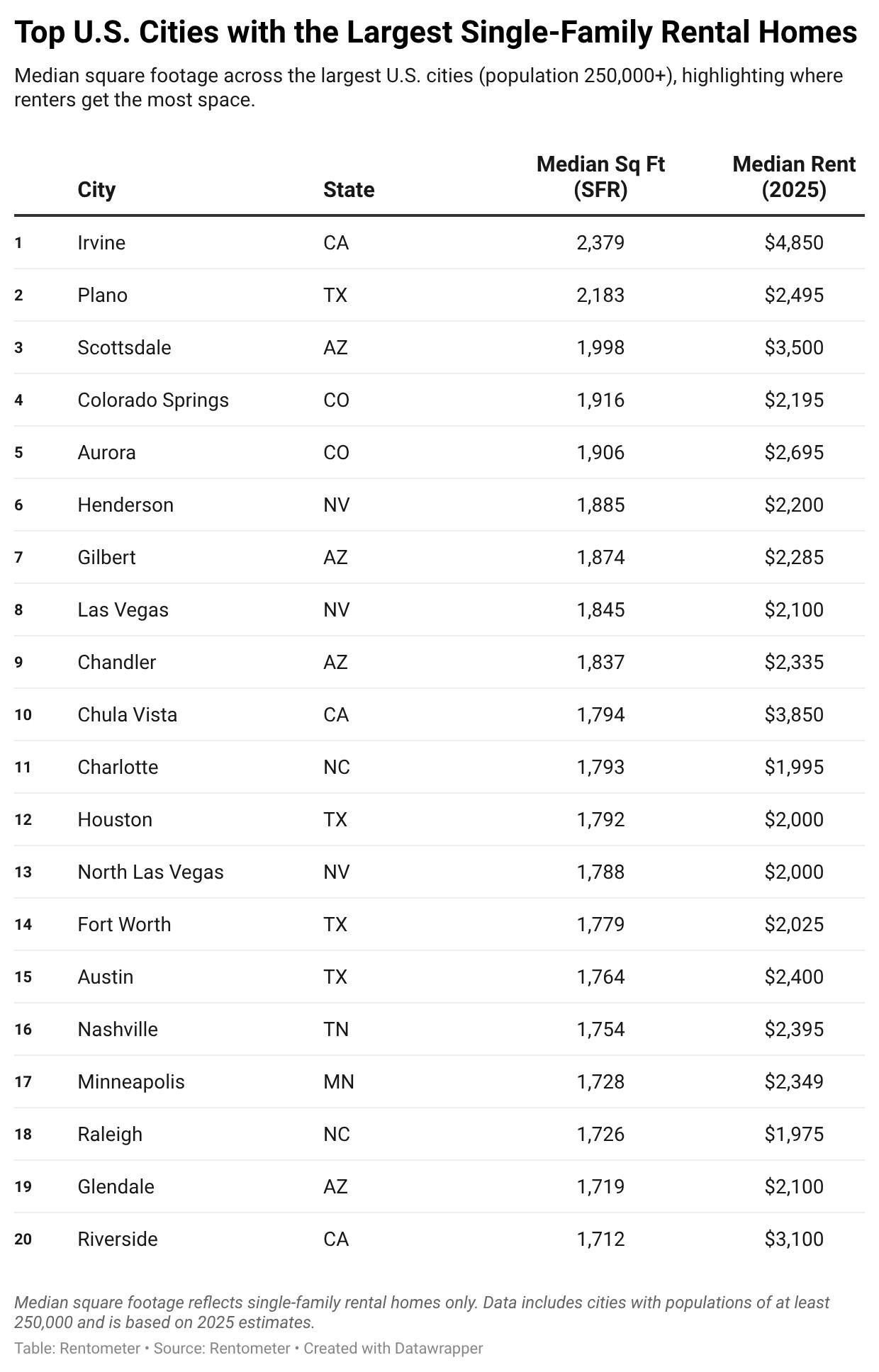
While big cities are often associated with smaller living spaces, our data on single-family rentals suggests a more nuanced picture. In many cities with populations over 250,000, renters can still find notably spacious homes, in some cases rivaling suburban properties.
Irvine, the second largest city in Orange County, California, ranks as the most spacious major city in our analysis, with a median of 2,379 sq ft, an outcome that may come as a surprise given California’s reputation for higher density and smaller living spaces.
Known for its master-planned communities, Irvine offers renters access to larger, well-designed homes within a highly developed urban setting, a combination that is relatively uncommon in coastal markets.
That said, this level of space often comes at a premium. In our 2025 analysis, Irvine ranked as the second most expensive city in the U.S. for renting a single-family home, second only to San Francisco, among cities with populations of at least 250,000. As a result, renters may need to balance space versus affordability when considering the area.
Plano, TX ranks as the city with the second largest single-family home rentals in our 2025 analysis, making it a standout destination for renters seeking more space. Plano exemplifies how single-family rentals can deliver a homeownership-like experience with greater flexibility, making it especially appealing for families and professionals in fast-growing metros.
This level of space, combined with modern amenities, high-quality housing stock, a buzzing local economy, and proximity to Dallas, has also made Plano the most expensive large city in Texas for renting a three-bedroom home, even surpassing other major metros in the state.
Still, with a median rent of $2,495, Plano remains significantly more affordable than top-tier coastal markets like Irvine and Seattle, offering renters far better value for the space and lifestyle it provides.
Scottsdale, AZ ranks among the top large U.S. cities for spacious single-family rentals, with a median home size of 1,998 sq ft, just shy of the 2,000 sq ft mark. What sets Scottsdale apart, however, is not just the size of its homes, but the premium lifestyle that comes with them. With a median rent of $3,500, it is one of the more expensive markets outside of California, reflecting strong demand driven by its upscale neighborhoods, resort-style amenities, and year-round appeal.
Compared to nearby Arizona cities like Gilbert or Chandler, Scottsdale commands a clear premium, but it also offers a more luxury-oriented rental experience. For renters prioritizing both square footage and lifestyle, Scottsdale stands out as one of the few large U.S. cities that delivers on both fronts.
Where Space Meets Value Across Major Cities
Beyond Irvine, Plano, and Scottsdale, a broader group of large U.S. cities demonstrates that renters can still find generous living space, often at far more accessible price points.
Several cities cluster just below the 2,000 sq ft mark, including Colorado Springs (1,916 sq ft; $2,195) and Aurora (1,906 sq ft; $2,695), offering a strong balance between space and affordability. These cities highlight how renters can access near top-tier square footage without entering the highest price brackets.
In the Southwest, cities like Henderson (1,885 sq ft; $2,200), Gilbert (1,874 sq ft; $2,285), and Chandler (1,837 sq ft; $2,335) stand out for delivering consistently large homes at moderate rents. Even Las Vegas (1,845 sq ft; $2,100) and North Las Vegas (1,788 sq ft; $2,000) provide substantial space at highly competitive price points, reinforcing the region’s reputation for value.
Meanwhile, some of the largest metros in the U.S. continue to offer a compelling middle ground. Cities like Charlotte (1,793 sq ft; $1,995), Houston (1,792 sq ft; $2,000), and Fort Worth (1,779 sq ft; $2,025) combine solid square footage with relatively affordable rents, making them attractive options for renters seeking both space and economic opportunity.
At the same time, higher-cost markets like Chula Vista (1,794 sq ft; $3,850) and Riverside (1,712 sq ft; $3,100) show that even when space is available, pricing can vary significantly depending on location, particularly in California.
Mid-Sized Cities, Maximum Space
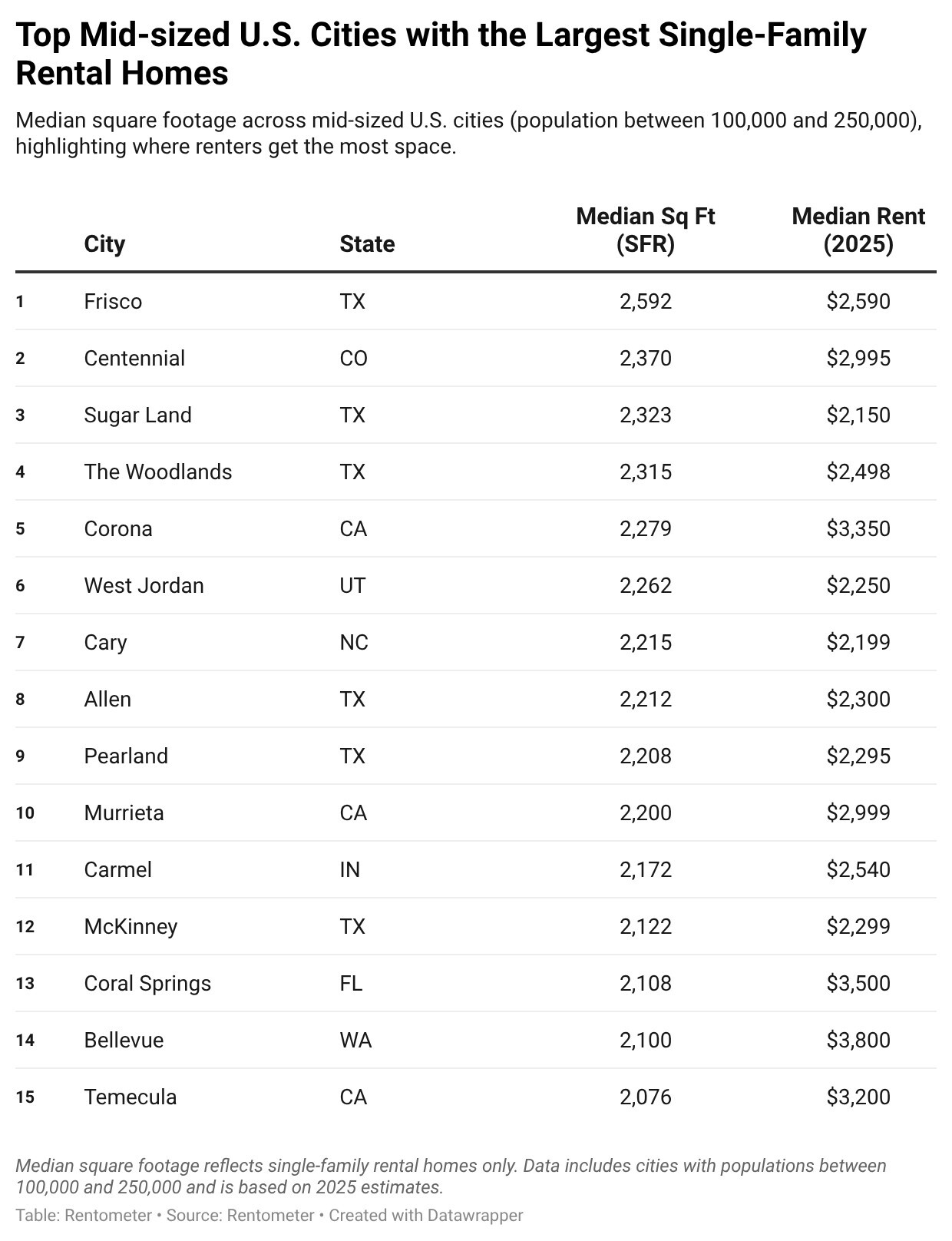
Mid-sized cities—defined here as those with populations between 100,000 and 250,000—are emerging as some of the most attractive markets for renters seeking both space and value. In many cases, these cities outperform larger metros, offering significantly bigger single-family homes without the same level of pricing pressure.
Leading the list is Frisco, TX, with an impressive 2,592 sq ft median home size and a rent of $2,590, followed closely by Centennial, CO (2,370 sq ft; $2,995) and Sugar Land, TX (2,323 sq ft; $2,150). These cities highlight a key trend: renters can access some of the largest homes in the country in markets that are still relatively manageable in size.
Texas, in particular, stands out with multiple entries including The Woodlands (2,315 sq ft; $2,498), Allen (2,212 sq ft; $2,300), McKinney (2,122 sq ft; $2,299), and Pearland (2,208 sq ft; $2,295), demonstrating the state’s strong supply of large, modern single-family homes.
Other regions also show strong performance. Cities like Cary, NC (2,215 sq ft; $2,199) and Carmel, IN (2,172 sq ft; $2,540) combine generous space with stable, family-oriented environments, while West Jordan, UT (2,262 sq ft; $2,250) reflects the Mountain West’s growing appeal for renters prioritizing larger homes.
Even in higher-cost states, mid-sized cities can deliver substantial space. Murrieta (2,200 sq ft; $2,999), Corona (2,279 sq ft; $3,350), and Temecula (2,076 sq ft; $3,200) offer large homes within California, though at a premium. Similarly, Bellevue, WA (2,100 sq ft; $3,800) and Coral Springs, FL (2,108 sq ft; $3,500) show that space in desirable markets often comes with higher rents.
Small Cities, Exceptionally Large Homes
Some of the largest single-family rental homes in the U.S. are not found in major metros. but in smaller cities with populations between 25,000 and 100,000. These markets represent some of the best opportunities for renters to access true suburban-style living with larger homes, quieter neighborhoods, and community-oriented environments without needing to buy.
At the top is Parkland, FL, a suburb of Miami, with a median of 2,964 sq ft, followed by Erie, CO (2,800 sq ft) and South Jordan, UT (2,729 sq ft). Texas also makes a strong showing with Prosper (2,704 sq ft), while Herriman, UT (2,692 sq ft) and Parker, CO (2,681 sq ft) reinforce the dominance of fast-growing Western markets.
These cities tend to feature newer housing stock, master-planned communities, and larger lot sizes, which translate into bigger homes designed for families. Affluent suburbs like Brentwood, TN (2,679 sq ft) and Sammamish, WA (2,615 sq ft) further illustrate how smaller cities can offer both space and high-end living, albeit often at a premium.
Meanwhile, markets like Waxhaw, NC (2,600 sq ft) and Park City, UT (2,596 sq ft) highlight the appeal of smaller, lifestyle-oriented communities where renters can access significantly more space than in traditional urban centers.
Where Space Is Tightest in Major U.S. Cities
At the other end of the spectrum, some of the largest U.S. cities offer significantly smaller single-family rental homes, highlighting just how much space can vary depending on location.
Leading the list is St. Louis, MO, with a median size of just 1,064 sq ft, followed by Detroit, MI (1,116 sq ft) and Jersey City, NJ (1,160 sq ft). These cities illustrate how older housing stock and more compact urban layouts can translate into smaller rental homes, even in markets where overall affordability is relatively strong.
Several Midwestern cities such as Toledo (1,188 sq ft), Milwaukee (1,200 sq ft), and Kansas City (1,296 sq ft) also rank among the smallest, though they often compensate with lower rents. For renters prioritizing cost over space, these markets can still offer solid value despite more limited square footage.
In contrast, some high-cost coastal markets deliver less space at a premium price. Cities like Long Beach, CA (1,240 sq ft; $4,026), Brooklyn, NY (1,250 sq ft; $3,881), and Oakland, CA (1,300 sq ft; $3,866) highlight the trade-off between location and size. Even Honolulu, HI (1,313 sq ft; $4,230), one of the most expensive markets in the dataset, offers relatively modest space compared to mainland cities.
Meanwhile, major urban centers such as Chicago (1,276 sq ft; $2,767), Philadelphia (1,200 sq ft; $1,997), and Columbus, OH (1,316 sq ft; $1,989) fall in the middle offering smaller homes than Sun Belt or Mountain West cities, but still maintaining a balance between space and access to jobs, amenities, and urban infrastructure.
While some large cities offer more compact single-family homes, they often make up for it with proximity to jobs, transit, and urban amenities highlighting the different ways renters can prioritize space versus location.
Curious how much space you could get where you live or where you’re considering moving? Explore your local market to see how square footage and rent compare across the country.
Methodology
This analysis is based on nearly 650,000 single-family rental listings collected in 2025. Median square footage is based on publicly available property data.
Rental Price Data
Rent figures come from the Rentometer rental comps database, based on advertised listings.
To ensure consistency:
- Cities with fewer than 25 new or updated listings per quarter were excluded
- Listings with rents below $500 or above $10,000 were removed
Geographic Scope
We included U.S. cities with populations of 25,000+ and all U.S. states.
Property Type
Only single-family rental homes were included.
Stay connected
Get rental market insights delivered straight to your inbox.